
If you’re standing at the point where you need to choose between TPO and EPDM roofing, chances are you’re not just comparing materials.
You’re comparing:
- Long-term peace of mind
- Budget pressure vs future savings
- “Will this last?” anxiety
- And that quiet fear of making the wrong decision
Roofing decisions don’t feel small. They sit above your business, your home, your investment, and your sleep.
So let’s slow this down — and talk like humans, not sales brochures.
Why TPO vs EPDM Feels So Confusing at First 😕
From the outside, both TPO and EPDM look similar.
Flat roofs. Commercial buildings. Rubber-like materials. Long lifespans.
Contractors throw around terms like: “Energy efficiency,” “Heat welding,” “Membrane thickness,” “UV resistance.”
And meanwhile, you’re thinking:
👉 “I just want a roof that doesn’t leak, doesn’t stress me out, and doesn’t cost me again in five years.”
That’s a fair expectation. And that’s exactly where this comparison should start.
The Root Difference Most People Miss (This Changes Everything) 🧠
Here’s the simplest way to understand it:
TPO is designed to reflect heat. EPDM is designed to absorb and survive it.
That one difference explains almost everything else.
Now let’s unpack it properly.
What Is TPO Roofing Really Like? ☀️
TPO (Thermoplastic Polyolefin) roofing is known for one big thing:
👉 Energy efficiency.
It’s usually white or light-colored, which reflects sunlight instead of absorbing it. In hot climates, this can significantly reduce cooling costs.
TPO roofs:
- Reflect UV rays
- Keep buildings cooler
- Work well in sunny, high-heat regions
- Are heat-welded at seams for strong bonding
Emotionally, TPO appeals to people who think: “I want modern, efficient, and future-focused.”
But here’s the part many people don’t hear right away…
What Is EPDM Roofing Really Like? 🌑
EPDM (Ethylene Propylene Diene Monomer) is often called rubber roofing.
It’s typically black, flexible, and incredibly durable.
EPDM roofs:
- Handle extreme temperature swings
- Expand and contract without cracking
- Perform well in cold climates
- Have a long track record (decades, not years)
Emotionally, EPDM appeals to people who think: “I want proven, tough, and reliable — no experiments.”
And that mindset matters more than people realize.
How Climate Quietly Decides for You 🌎
Let’s be honest — your roof doesn’t live in a brochure. It lives in your climate.
In Hot & Sunny States ☀️
TPO often shines because:
- It reflects heat
- Reduces AC load
- Keeps interiors cooler
- Can lower energy bills
In Cold or Variable Climates ❄️
EPDM often wins because:
- It stays flexible in freezing temperatures
- Doesn’t crack easily
- Handles snow and ice well
- Survives expansion and contraction
Ask yourself honestly: 👉 Is my bigger enemy heat… or weather stress?
Installation: Where the Experience Really Matters 🔧
This is where emotions turn into outcomes.
TPO requires:
- Skilled heat welding
- Precise installation
- Consistent quality control
EPDM allows:
- Adhesive or mechanical attachment
- Simpler repair methods
- Easier patching if damage occurs
A poorly installed TPO roof can fail early. A well-installed EPDM roof can quietly last decades.
So the real question becomes: 👉 Who is installing it — and how experienced are they with this system?
Maintenance & Repairs (The Part Nobody Thinks About Until It’s Too Late) 😬
Let’s be real.
Every roof will need attention someday.
With TPO:
- Repairs often require specialized tools
- Seam issues need professional handling
- DIY fixes are limited
With EPDM:
- Repairs are simpler
- Patches are easier
- Maintenance feels less stressful
People who’ve dealt with emergency leaks often say: “I wish I’d thought about repairs before choosing.”
That’s wisdom talking — not regret.
Cost vs Value (Not the Same Thing) 💰
Upfront costs can be similar depending on region and thickness.
But long-term value depends on:
- Climate compatibility
- Installation quality
- Maintenance needs
- Energy savings
- Repair ease
Some people save on energy with TPO. Others save on longevity with EPDM.
There’s no universal winner — only a better fit.
Let Me Ask You This 🤔
Are you the type of person who:
- Likes modern solutions and efficiency?
- Or prefers proven durability and simplicity?
Do you want:
- Lower cooling bills?
- Or fewer repair worries?
There’s no wrong answer — only honest alignment.
A Smarter Paradigm Before the Conclusion 🔄
Most people ask: “Which roof is better?”
A better question is: 👉 “Which roof will make me worry less over the next 20 years?”
That’s the paradigm shift.
Roofing isn’t about materials. It’s about mental peace.
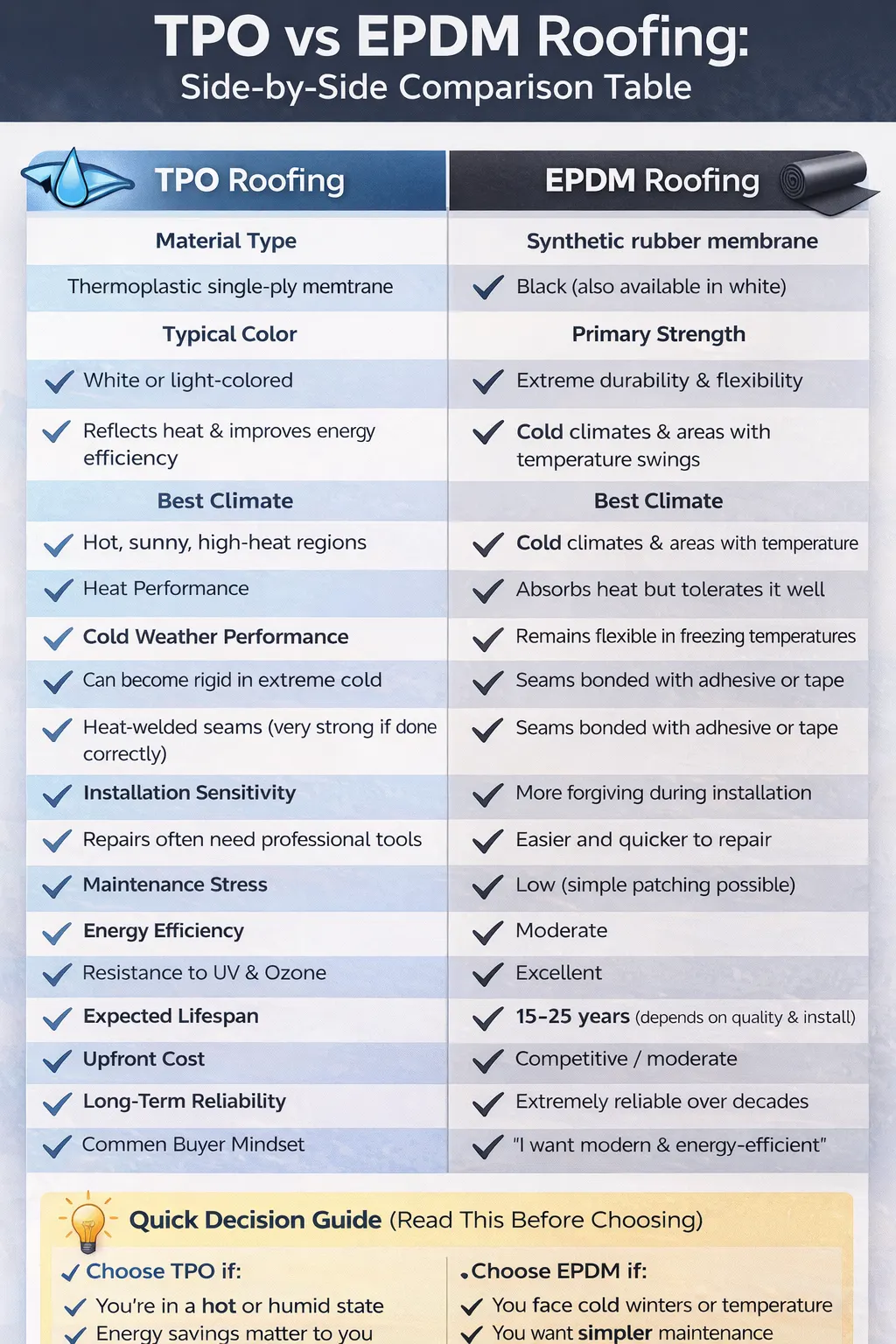
TPO vs EPDM Roofing: Side-by-Side Comparison Table
Powerful Guidance to Make the Right Choice ✅
Here’s a grounded way to decide:
Choose TPO if:
- You’re in a hot, sunny climate
- Energy efficiency matters deeply
- You trust your installer’s expertise
- You want a reflective, modern system
Choose EPDM if:
- You experience cold or extreme weather swings
- You value flexibility and durability
- You want easier long-term repairs
- You prefer proven performance
Neither choice is wrong. The wrong move is choosing blindly.
Your Powerful Conclusion: The Best Roof Is the One You Don’t Have to Think About 🏡✨
The real goal of a roof isn’t performance specs.
It’s this:
You stop thinking about it.
You stop worrying during storms. You stop checking ceilings after heavy rain. You stop wondering if you made a mistake.
Whether you choose TPO or EPDM, the best roof is the one that:
- Fits your climate
- Matches your priorities
- Is installed with care
- Lets you sleep peacefully
So don’t ask which roof is more popular.
Ask: 👉 Which roof feels right for my building, my climate, and my peace of mind?
Because when your roof is right, everything underneath it feels safer. 💙